
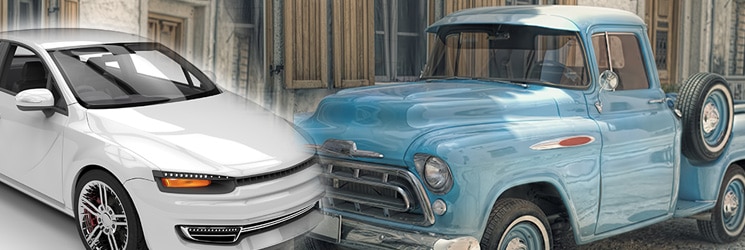
The windshield in front of you is the product of roughly a century of engineering, most of it driven by one problem: early cars used ordinary window glass, and ordinary window glass is dangerous in a crash.
It is a short history, and knowing it explains a lot about why modern auto glass behaves the way it does — and why the quality of a replacement matters.
The problem with early automotive glass
The first automobiles were fitted with the same plate glass used in houses and storefronts. It did not take long for two failures to become obvious.
The first was ordinary breakage. Early roads were rough, early suspensions were crude, and constant vibration cracked glass that was never designed to flex.
The second was far worse. In a collision, plate glass breaks into long, knife-edged shards. In the era before seat belts, occupants were regularly thrown into the windshield — and the injuries from the glass itself were often more serious than the impact.
The laminated breakthrough
The solution came from an accident in a laboratory in the early 1900s. A French chemist knocked a glass flask off a shelf and it cracked without shattering — a cellulose nitrate solution had dried inside it and was holding the pieces together. He patented the idea of bonding a plastic layer between sheets of glass.
The principle has not changed since: laminate the glass to a flexible interlayer and, when the glass breaks, the fragments stay stuck to the plastic rather than flying loose.
Adoption was slow at first, because early safety glass was expensive and the technology was imperfect — the interlayer tended to yellow and cloud with age, and it could still be penetrated in a serious impact. Manufacturers used it only for windshields, and often only as a paid option.
That changed through the 1920s and 1930s. American manufacturers refined the process, costs came down, and Ford became one of the first to adopt laminated windshields at scale. By the time federal safety standards began mandating safety glazing in motor vehicles, the industry had already largely moved to it.
How modern auto glass improved on it
The basic architecture is the same today. What changed is the materials and what else the glass is asked to do.
Better interlayers. Modern windshields use polyvinyl butyral or ethylene-vinyl acetate rather than early cellulose-based plastics. These do not yellow, they hold their bond for the life of the vehicle, and they are far more resistant to penetration.
Tempered glass for the side and rear. Laminated glass is the right answer for a windshield, but the side windows took a different path: controlled heating and rapid cooling that puts the surface in compression. Tempered glass is several times stronger than ordinary glass and, when it does break, it goes all at once into small blunt fragments instead of shards.
Acoustic layers. Some interlayers are engineered to damp sound. A vehicle with acoustic glass is noticeably quieter at highway speed — and replacing it with plain glass takes that away permanently.
Solar control. Coatings and tinted interlayers reject a share of infrared radiation while passing visible light. In the Southwest this is not a luxury feature; it is a meaningful part of how hot the cabin gets.
Embedded technology. Modern glass may carry heating elements, antennas, rain sensors, humidity sensors and mounting brackets for a forward-facing camera. The windshield stopped being a passive part some time ago.
What a century of engineering means for your replacement
All of that history is the reason a replacement is not simply a matter of finding a pane the right shape.
The glass has to match what your vehicle originally had. Acoustic, solar, heated and sensor-equipped glass are all different parts. Fitting plain glass to a vehicle that came with acoustic solar glass leaves you with a louder, hotter car every day you own it — and the difference is not obvious in the parking lot.
The bond has to be right. A laminated windshield only contributes structural strength if it is properly adhered to the frame. That means the correct urethane, a properly prepared pinch weld, and enough cure time before the vehicle is driven.
The electronics have to be recalibrated. If a driver-assist camera looks through the glass, it needs recalibrating afterward. A century of glass engineering does not help if the safety system reading through it is aimed slightly wrong.
Where we come in
Andy’s American Glass has been repairing and replacing automotive glass in Tucson for over forty years. We stock glass for a wide range of makes and models, we match what your vehicle originally had rather than substituting down, we use adhesives rated for Arizona conditions, and we calibrate ADAS cameras after replacement.
Whether you need a chip filled, a windshield replaced, a side window replaced, or glass for a classic vehicle, we can help — at our shop or through our mobile service.
Want the technical version? Read what auto safety glass actually is, or get a free quote.