
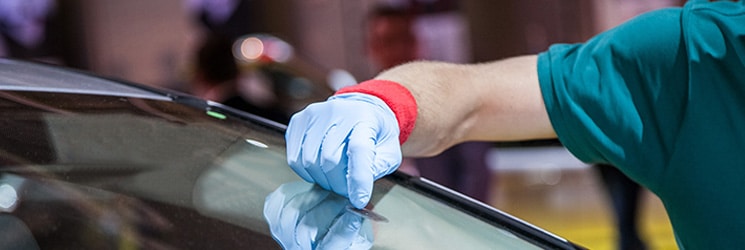
Most people think of a windshield as a window. It is closer to a structural component that happens to be transparent — and the reason it can do that job is that it is not ordinary glass.
Here is what automotive safety glass actually is, the two types your vehicle uses and why they are different, and what that means when yours gets damaged.
What auto safety glass does
Ordinary window glass is brittle and breaks into long, sharp shards. That is survivable in a house. In a vehicle at speed it is not, which is why safety glazing has been required in motor vehicles for decades.
Automotive safety glass does three jobs at once:
- It adds structural strength. The windshield is bonded to the vehicle’s frame and contributes a substantial share of the cabin’s rigidity — industry figures commonly put it at up to 60% of roof strength in a rollover.
- It keeps occupants inside the vehicle. A laminated windshield that stays in its opening is a barrier. One that leaves the opening is not.
- It positions the passenger airbag. The airbag is designed to deploy against the inside of the windshield and be redirected toward the passenger. If the glass gives way, the airbag does not go where it was engineered to go.
That is the reason a cracked windshield is worth dealing with promptly rather than living with. It is not about the view.
The two types, and where each one is used
This gets muddled often enough to be worth stating plainly: your windshield and your side windows are not the same kind of glass.
Laminated glass — your windshield
Laminated glass is two layers of glass bonded to a tough plastic interlayer, usually polyvinyl butyral. Struck hard, it cracks — that is the familiar spider-web pattern — but the fragments stay stuck to the plastic layer rather than leaving the opening. The pane holds together and stays in the frame.
That property is precisely why a windshield can serve as a structural member and an airbag backstop. It is also why chip damage in laminated glass can often be repaired: resin injected into the break bonds to the glass and restores strength, because the pane is still intact.
Tempered glass — your side and rear windows
Tempered glass is a single pane put through controlled heating and rapid cooling, which locks the surface in compression and the core in tension. That balance of internal stress makes it several times stronger than ordinary glass of the same thickness.
When it does fail, it fails completely: the stored stress releases at once and the whole pane breaks into small, blunt-edged pieces rather than jagged shards. Those pieces rarely cause serious lacerations — which is the entire point.
The trade-off is that tempered glass cannot be repaired. There is no in-between state. A damaged side window is a replacement, never a repair. It also cannot be cut or drilled after tempering, which is why every pane is made to final size before it is treated.
What this means when your glass is damaged
Windshield chip or short crack: often repairable, and the sooner the better. Resin bonds to clean glass, and in Tucson a break fills with dust and monsoon moisture within days. Windshield repair takes under an hour and many Arizona comprehensive policies cover it.
Windshield damage in the driver’s sightline, at the edge, or through both layers: that is a replacement. A repair in the sightline leaves optical distortion you will notice daily, and a crack that has reached the edge has compromised the bond to the frame.
Side or rear window: replacement, always.
Why the installation matters as much as the glass
Safety glass only performs if it is bonded correctly. Three things decide that:
- The right glass. Many vehicles sold in the Southwest have solar or acoustic interlayers, heating elements, or antenna elements in the glass. Replacing that with the cheapest pane that fits the opening loses those functions permanently.
- The right adhesive, correctly cured. Urethane needs to reach a minimum strength before the vehicle is safe to drive, and how long that takes depends on the product, the temperature and the humidity — which behave differently in Tucson’s dry heat. A shop that will not give you a safe drive-away time is skipping a safety step.
- A clean, sound pinch weld. The adhesive bonds to the frame. If there is corrosion under the old glass it has to be treated first, because adhesive bonded to rust is not bonded to anything.
And the camera behind the glass
If your vehicle has lane departure warning, automatic emergency braking or adaptive cruise control, a forward-facing camera looks through the windshield. New glass changes that camera’s aim slightly — enough to matter. It has to be recalibrated, or the system will keep reporting normal operation while reading the road slightly wrong. Ask whether calibration is included before you book.
Beyond vehicles
The same two technologies show up throughout a building. Tempered glass is required by code in shower enclosures, entrance doors and any pane near a walking surface, for exactly the same fragmentation reason. Laminated glass is what makes commercial security glazing hold together under impact, and it blocks most UV as a side benefit.
Andy’s American Glass works with all of it — auto, residential and commercial. We use OEM-equivalent glass matched to what your vehicle originally had, adhesives rated for Arizona conditions, and we calibrate ADAS cameras after replacement.
Get a free quote, or read more about what Tucson heat does to auto glass.