
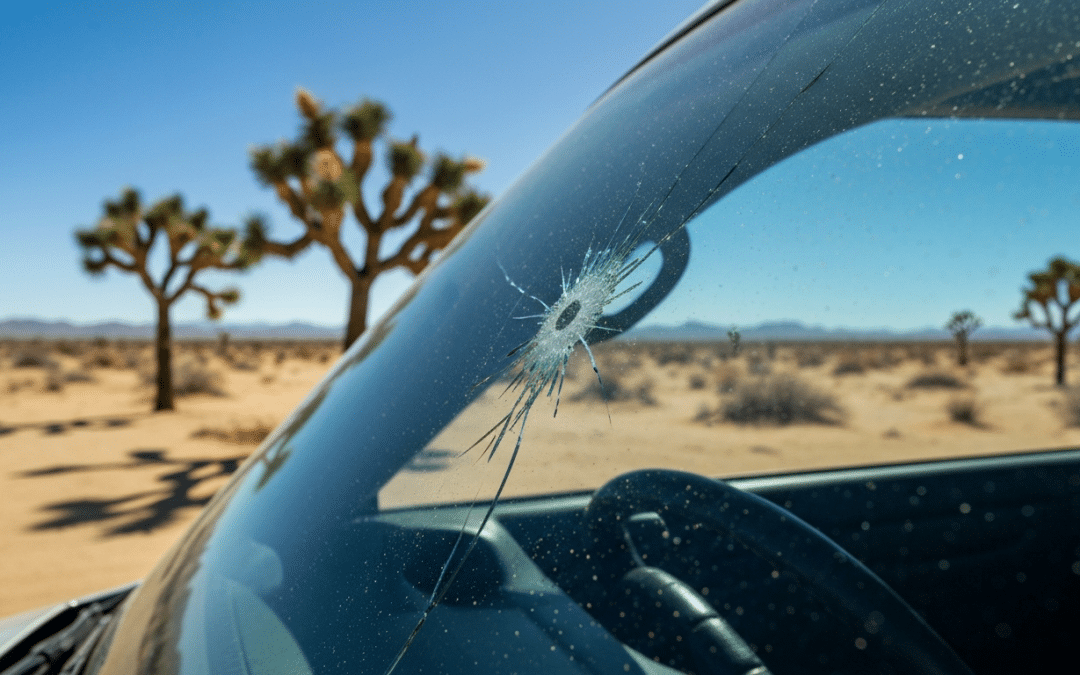
If you have lived through a Tucson summer, you already know what 108°F does to a steering wheel. What most drivers do not realize is that the same heat is quietly working on the windshield — and that a chip you could have covered with a dime in May can become a crack running the full width of the glass by the end of June.
Here is what is actually happening to your auto glass in the Sonoran Desert, and what you can do about it before a cheap repair turns into a full replacement.
Why heat turns a small chip into a long crack
A modern windshield is laminated safety glass: two layers of glass bonded to a plastic interlayer. Glass expands when it heats and contracts when it cools. That is normal and the windshield is built for it.
The problem is that heat does not arrive evenly. Park facing west on Speedway in July and the top of the glass bakes in direct sun while the bottom sits in the shadow of the dash. One area expands faster than the area next to it, and the glass has to absorb that difference. Undamaged glass handles it fine. Glass with a chip in it does not — a chip is already a weak point, and stress travels straight to it.
That is why so many Tucson windshields fail on a specific kind of day: the car sits in the sun all afternoon, the driver gets in, and the air conditioning goes on full blast against the inside of a 150°F windshield. The sudden temperature difference across the glass is often the moment a stable chip decides to run.
The everyday habits that make it worse
- Full-blast AC on a hot windshield. Start the air on low and let the cabin come down gradually. Cracking the windows for the first minute helps more than people expect.
- Cold water on hot glass. Rinsing a scorching windshield at the car wash is a fast way to shock damaged glass.
- Slamming doors. A closed car is a sealed box. Slamming a door spikes the internal pressure, and that pressure pushes on the glass.
- Waiting. This is the big one. Monsoon debris, washboard roads and thermal cycling all get their turn at that chip. Time is not on your side here.
Repair or replace? The honest answer
Most drivers assume a crack means a new windshield. Often it does not. Whether damage can be repaired depends on three things: size, location, and how long it has been there.
As a general rule, chips smaller than a quarter and cracks shorter than about six inches are good candidates for resin repair. A technician injects a clear resin into the break, draws out the trapped air, and cures it. The repair restores structural strength and stops the damage spreading. It is fast, it is a fraction of the cost of replacement, and many insurance policies cover it outright.
Repair stops being the right call when:
- The damage sits directly in the driver’s line of sight, where even a well-executed repair leaves slight distortion.
- The crack reaches the edge of the windshield, which compromises the bond to the frame.
- The break has gone through both layers of glass.
- Dirt and moisture have had weeks to work their way in — contaminated breaks do not bond cleanly.
That last point is the one that costs Tucson drivers money. A chip repaired in the first few days is straightforward. The same chip in August, after a month of dust and monsoon rain, frequently cannot be saved. If you have a chip right now, have it looked at this week, not next month.
Why a windshield is a safety component, not a window
It is worth being blunt about this, because it changes how you should think about putting the job off.
Your windshield is bonded to the vehicle’s frame and contributes a significant share of the roof’s structural strength in a rollover. It is also the surface your passenger airbag deploys against — the airbag is designed to hit the glass and be redirected toward the passenger. A windshield that is cracked, or that was installed with the wrong adhesive or before the adhesive cured, can fail in exactly the moment it matters most.
This is also why drive-away time is not a formality. Urethane adhesive needs to reach a minimum strength before the vehicle is safe to drive, and how long that takes depends on the product, the temperature and the humidity. In Tucson’s dry heat those numbers behave differently than they do at sea level. A shop that hands you the keys without telling you a safe drive-away time is not doing you a favor.
ADAS calibration
If your vehicle has lane departure warning, automatic emergency braking, adaptive cruise control or a similar system, there is a camera looking through the windshield. Replace the glass and that camera’s aim changes by a small amount — enough to matter. The system has to be recalibrated afterward or it may read the road incorrectly while still telling you it is working. Ask any shop directly whether calibration is included before you book.
Arizona-specific things worth knowing
Windshield damage and the law. Arizona requires that a driver’s view be unobstructed. A crack spreading across the driver’s side can draw a citation, and it can complicate an insurance claim after an accident.
Glass coverage. Comprehensive auto policies in Arizona frequently include glass coverage, and some carriers waive the deductible for repairs specifically because a repair is far cheaper for them than a replacement. It is worth a five-minute call to your insurer to find out what your policy actually says — a lot of people pay out of pocket for work that was already covered.
Tinted and acoustic glass. Many vehicles sold in the Southwest have a solar or acoustic interlayer. If yours does, it needs to be replaced with equivalent glass, not the cheapest pane that fits the opening. The difference shows up in cabin heat and road noise every day you own the car.
Getting ahead of it
The practical version of all this is short. Park in shade when you can. Use a windshield sunshade — it is the single cheapest thing you can do. Ease into the air conditioning instead of blasting a hot windshield. Keep your distance behind gravel trucks. And when you do take a rock, deal with the chip while it is still a chip.
Andy’s American Glass has been repairing and replacing auto glass in Tucson for decades, and we have seen what this climate does to it. We use OEM-equivalent glass, temperature-appropriate adhesives rated for Arizona conditions, and we calibrate ADAS cameras after replacement. If you would rather not sit in a waiting room, our mobile service comes to your home or office anywhere in the Tucson metro.
Got a chip? Have it repaired before the heat spreads it, or get a free quote and we will tell you honestly whether it can be saved.