
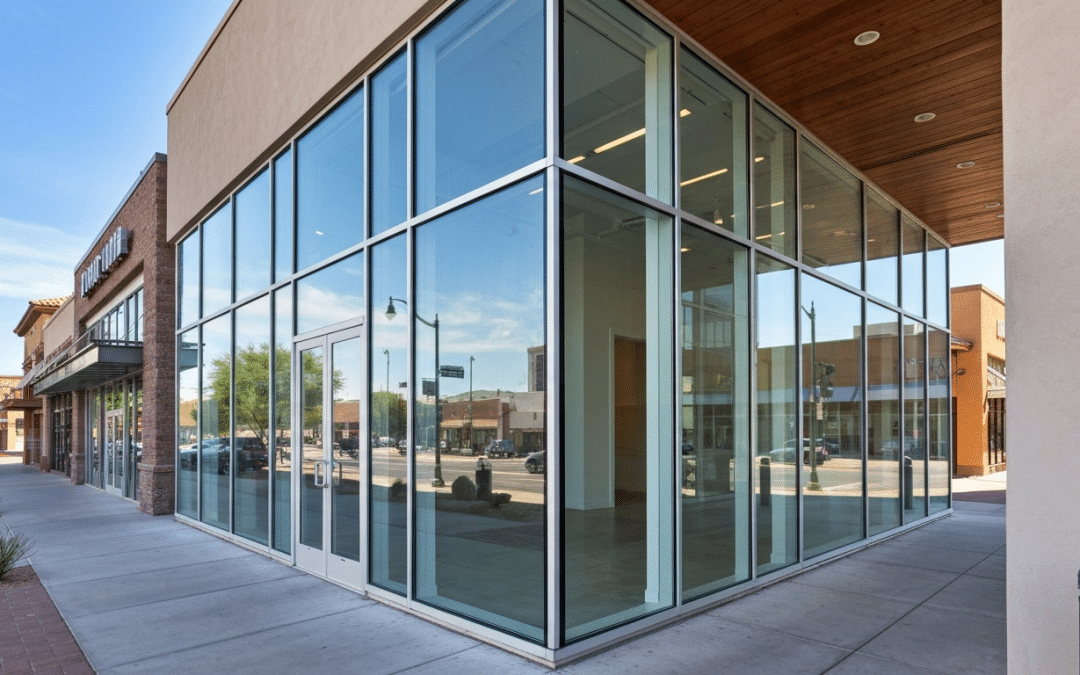
A customer decides something about your business before they touch the door. Clouded glass, a bent frame, tape over a crack — these read as neglect whether or not the business behind them is thriving. Clean, modern storefront glass reads as competence.
That is the surface argument for upgrading, and it is real. But the case for modern commercial glass in Tucson is mostly about three things that do not show up in photographs: cooling costs, security, and code.
Energy performance, and why it matters more here
In a Tucson retail space, the storefront is the single largest thermal weak point in the building. Everything else is insulated. The glass is not — and it faces the desert sun for most of the day.
Older single-pane storefront glass in an aluminum frame does close to nothing to stop solar heat. It comes straight through the glass, and heat also conducts through the untreated aluminum frame, which is an excellent thermal conductor. Your air conditioning fights that for every hour you are open, from April through October.
Modern commercial glazing addresses both:
- Low-E coatings are microscopically thin metallic layers that reflect infrared radiation while letting visible light through. You keep the daylight and the view; you reject a large share of the heat.
- Insulated glass units use two panes with a sealed gap, often argon-filled, which dramatically reduces conductive heat transfer compared with a single pane.
- Thermally broken frames put an insulating barrier between the inside and outside halves of the aluminum, cutting the frame’s role as a heat bridge.
- Tinted and spectrally selective glass reduces glare and solar gain, which matters for west-facing storefronts on Speedway, Broadway, Oracle — anywhere afternoon sun hits the glass directly.
The comfort difference is immediate: no hot zone near the front of the store, less glare on merchandise and screens, and less strain on an HVAC system that will last longer for it. Utility savings vary too much by building to promise a number honestly, but in a climate with our cooling season, storefront glazing is one of the more consequential envelope decisions a Tucson business makes.
Security
Commercial glass options range well beyond ordinary glazing.
Tempered glass is required by code in most storefront applications. It is several times stronger than annealed glass and breaks into small blunt fragments rather than large shards.
Laminated glass bonds two panes to a tough interlayer. Struck hard, it cracks but tends to stay in the opening rather than collapsing — which is what turns a smash-and-grab into a noisy failed attempt. It also blocks most UV, protecting merchandise and fixtures from fading, and it damps street noise noticeably.
Security film applied to existing glass is a lower-cost middle path that holds fragments together on impact. It is not equivalent to laminated glass, but it is a real improvement over bare glazing when full replacement is not in this year’s budget.
For businesses that have been hit before, or that hold high-value inventory, laminated glass is usually the right answer. The cost difference over tempered is modest compared with one break-in and the emergency board-up that follows.
Code, accessibility and liability
Storefront glazing sits inside a stack of requirements that is easy to fall out of compliance with during a renovation.
Safety glazing is mandated in doors, sidelites and any pane within a defined distance of a walking surface. Entrances must meet ADA requirements for clear width and opening force — door hardware and closers drift out of adjustment over years, and a door that is too heavy to open is a compliance problem as well as a customer problem. And a glass entrance that is not clearly marked can be walked into; visible hardware, a rail, or applied graphics resolve it.
These are not the exciting part of a storefront upgrade, but they are the part that turns into liability if they are wrong. Any commercial glazing job should include a look at the whole entrance, not just the pane being replaced.
Practical considerations for a Tucson storefront
Do the whole elevation, not one pane. A single new insulated unit next to four old single panes will look mismatched from across the street — new glass reads differently in color and reflectivity. If budget requires phasing, phase by elevation rather than by pane.
Sun orientation should drive the spec. A west-facing entrance takes the worst of the afternoon load and justifies a more aggressive solar-control specification than a north-facing one. Specifying one product for every elevation wastes money on some and underperforms on others.
Plan the downtime. Storefront replacement is disruptive by nature. Ask about temporary security between removal and installation, and schedule around your quietest days. Any competent commercial glazier will work with your hours.
Check the frames before you price the glass. Aluminum storefront framing outlasts glazing by decades, and often the existing frames are sound and only the glazing and gaskets need attention. That is a materially cheaper job. Sometimes the frames are corroded or racked and need replacing. You want to know which situation you are in before you budget.
Where it makes the most difference
Retail benefits most visibly — better light, less glare on displays, a front that signals the business is doing well. Restaurants gain comfortable window seating that is currently unusable in July. Offices get glare control at desks near the glass and a professional entrance. Medical and professional practices get quiet, privacy options through frosted or patterned glazing, and an entrance that reflects the standard of care inside.
Start with an assessment
Before pricing anything, get someone to look at what you actually have: frame condition, current glazing type, sun exposure by elevation, and how the entrance measures against current code. That assessment usually reveals that the job is smaller than feared, or that the real problem is somewhere other than where you thought.
Andy’s American Glass handles storefront glass installation and repair, commercial door glass, safety and security glazing and interior office glass for businesses across Southern Arizona — and we are available for emergency board-up when something goes wrong outside business hours.
Request a commercial glass assessment and we will tell you what your storefront actually needs.