
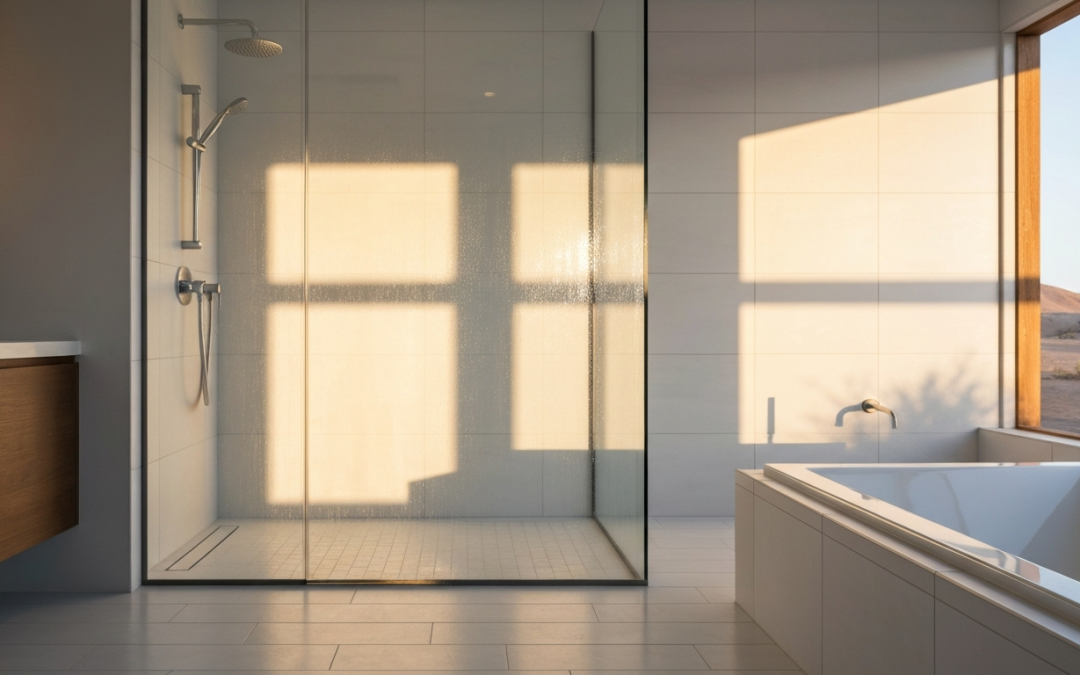
It is the question that stalls more Tucson bathroom remodels than tile choice: frameless or framed? The frameless enclosure in the showroom looks like the obvious winner right up until you see the price difference. So which one is actually right for your house?
Here is a straight comparison — cost, cleaning, durability, and the practical constraints of a real bathroom — without pretending one answer fits everyone.
What actually separates them
Framed enclosures use relatively thin glass, typically 3/16 of an inch, held in a metal frame around every edge. The frame carries the structural load, so the glass does not have to.
Frameless enclosures use thick tempered glass — 3/8 or 1/2 inch — that supports itself. Hardware is limited to hinges and a handle, mounted directly through the glass into the wall studs.
Semi-frameless sits between them: heavier glass than framed, with framing on some edges only. It is a genuinely good middle option that gets overlooked because it does not have a showroom identity.
Appearance
This is where frameless earns its reputation. With no metal breaking up the sightline, the eye reads the whole room rather than stopping at the shower. In a small Tucson bathroom — and a lot of mid-century homes here have small bathrooms — that is not just an aesthetic preference, it genuinely makes the space feel larger. It also puts your tile work on display, which matters if you spent money on it.
Framed enclosures do not have to look dated. Matte black and brushed gold framing have moved the category a long way from the builder-grade chrome most people picture. But the frame is a visual line, and it will always be one.
Cleaning — and Tucson water
This is the deciding factor for more homeowners here than any other, and it is worth being specific.
Tucson has hard water. Dissolved calcium and magnesium are left behind when a droplet evaporates, which is why glass here spots faster than it does in softer-water cities.
Framed enclosures have a metal track along the bottom and channels around the edges. Those channels collect water, and water that sits collects soap scum, mineral deposits and eventually mildew. Cleaning them properly means getting into a narrow track with a brush. Most people do not, which is why an aging framed enclosure often looks worse than it is.
Frameless glass has almost nowhere for water to sit. A squeegee after each shower takes fifteen seconds and keeps it genuinely clear. The trade-off: with nothing to hide behind, hard-water spotting on frameless glass is immediately visible if you skip it.
If you are choosing frameless in Tucson, ask about a protective coating. A hydrophobic treatment applied to the glass makes droplets bead and run rather than sitting and evaporating, which substantially slows mineral buildup. It is not permanent and it is not magic, but it meaningfully reduces how often you are scrubbing.
Durability
Both are tempered safety glass, required by code for shower enclosures. Tempered glass is several times stronger than annealed glass and, if it does break, fragments into small blunt pieces rather than shards.
Thicker frameless glass is more resistant to flexing and everyday impact. Its vulnerability is the edges — a sharp knock on an exposed edge is the realistic failure mode, which is why professional installation with proper clearances matters.
Framed enclosures protect the glass edges inside the frame. Their weak point is the hardware over time: rollers wear, tracks corrode, and seals harden and shrink. Those parts are replaceable, which is a real advantage — a tired framed enclosure can often be brought back to life for a fraction of a full replacement.
Cost
Frameless costs more, and the reasons are structural rather than arbitrary. The glass is two to three times thicker and heavier. It must be measured, cut and tempered to your exact opening — tempered glass cannot be trimmed after the fact, so there is no margin for error. Hardware must anchor into studs or blocking. And installation takes two people and considerably more time.
Framed enclosures use more standardized components, are lighter, and are more forgiving of walls that are not perfectly plumb. That last point is not a small thing in older Tucson homes.
The constraint nobody mentions: are your walls straight?
Frameless glass is a rigid rectangle. Your bathroom, particularly in a home built before the 1980s, may not be. A frame can absorb a quarter inch of variation with trim and sealant. Frameless cannot — the glass is cut to what is actually there, and any out-of-plumb wall shows up as an uneven gap.
A good installer measures the opening at several heights, checks plumb and level, and tells you honestly what the result will look like before anything is ordered. If a wall is far enough out that frameless will look wrong, semi-frameless is usually the answer. It is not a downgrade; it is the right tool.
So which should you choose?
Choose frameless if you want the open look, you are willing to squeegee, your bathroom is small enough that visual openness matters, you are already investing in tile worth showing off, or you are thinking about resale value.
Choose framed if budget is the priority, you want the lowest-maintenance option in terms of not worrying about spotting, you are working with walls that are noticeably out of plumb, or it is a guest bathroom that gets light use.
Choose semi-frameless if you want most of the open look at a lower cost, or your walls need a little forgiveness. For a lot of Tucson homes this is quietly the best answer.
Getting it measured properly
Whichever you pick, the enclosure is made to your opening — there is no adjusting it afterward. That makes accurate measurement the whole job. Andy’s American Glass measures in person, checks the walls before quoting, and fabricates to those numbers.
Have a look at our custom shower glass and shower door options, or book a free in-home consultation and we will tell you which option actually suits your bathroom — including when the cheaper one is the right call.